
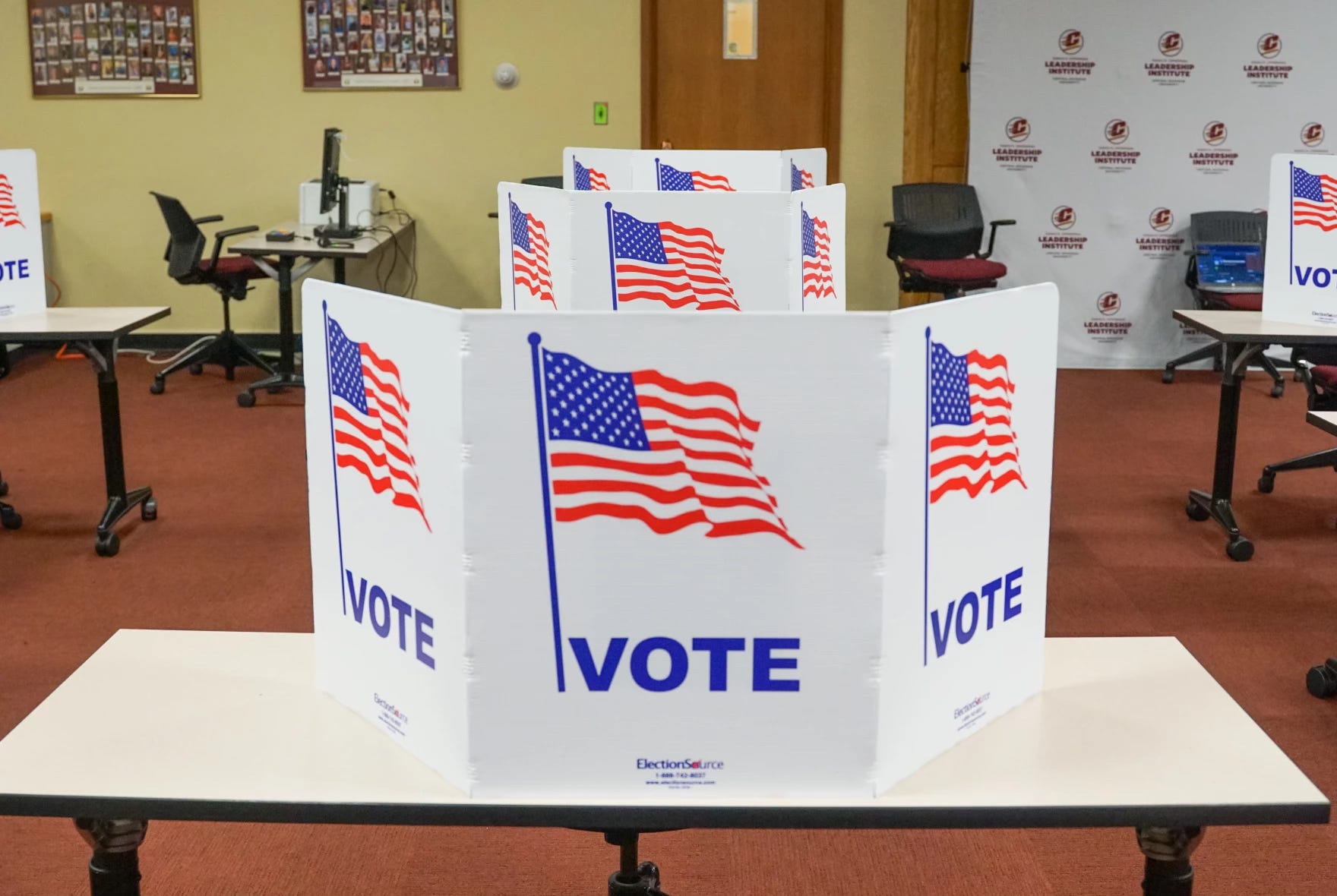
The August 4 primary gave us both Senate and House of Representative candidates: Abdul El-Sayed for Senate and Callie Barr for US House of Representatives, District 1.
Abdul El-Sayed will be running against Mike Rogers in the November elections (the incumbent—Senator Gary Peters, Democrat, is retiring).
Callie Barr will be running against our U.S. Congressman Jack Bergman, who is running for his 6th term in office.
Locally, the Antrim Dems had excellent candidates in all races.
Leading up to the Primaries was exciting. Antrim Dems had a chance to meet many of the candidates. We now know all the ways we can drive around Torch Lake to get to Elk Rapids and Bellaire, and all the drink and food options at Shorts Pull Barn (ER) and Shorts on Bridge Street (Bellaire). There were also meet and greets at Art and Connections (ER) and BeeWell (Bellaire). As always, a big shout out to our local coffee houses, shops, and pubs for becoming excellent places to meet old friends and new.
We have excellent candidates running across the board. In the weeks to come, we’ll be interviewing candidates for the Antrim races ( for example Mitch Distin in the 104th District/MI State Legislature, Rachel Longendyke Teeter in the 105th District/MI State Legislature and Kate Gallup in the 37th District/MI Senate race.
We elected many fine Precinct Delegates locally. They’ll be working hard to meet their neighbors and get the word out about the excellent Dems who are running.
The Antrim Dems are an amazing, energized, smart and yes, creative group. The Newsletter is looking forward to biweekly reports as we “Go for Blue” in Antrim County!
Here are the Antrim County results as reported by 9and10news. Note that the Dems got out there! Thanks to everyone for showing up and voting.
Keep your eyes peeled for our Michigan blue support of our candidates.
CLICK HERE FOR THE FULL CALENDAR OF REGULAR EVENTS ON OUR WEBSITE

JOIN OR RENEW YOUR 2026 MEMBERSHIP

A huge shoutout
…To Martha Davidson who has been our Antrim Dems Treasurer for years. Martha, thank you so much for ALL you have done for the Antrim Dems!!!
A big welcome to our new Antrim Dems Treasurer Steve Klotz 62klotz@gmail.com.
Thanks, Steve, and welcome aboard!
ANTRIM DEMS HAVE THE AD-VANTAGE
The Ad Team is hard at work creating ads that will draw folks in – looking out for us all, rather than locking people out.
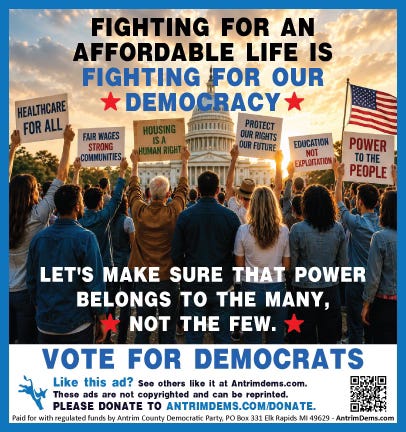
And we care about the beauty and richness of our natural resources.
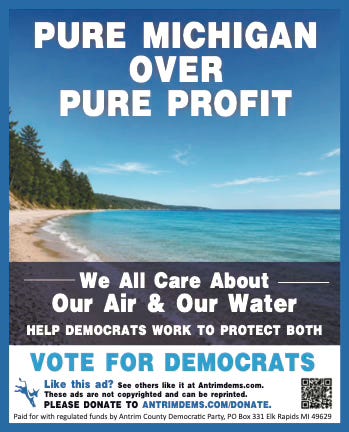
We appreciate your support! Every dollar goes toward our efforts to get the word out.
Or you can mail a check to:
Antrim County Democratic Party
P.O. Box 331
Elk Rapids, MI 49629
· Official Website: Antrim County Democratic Party
· Facebook Page: Antrim County Democratic Party on Facebook
Thanks for your support!

An Update on the Recall Effort
On August 6, the Attorney General’s Office issued a press release indicating they found no criminal conduct by Antrim County Clerk Victory Bishop in regard to allowing her husband unsupervised access to her office and computer.
The press release goes on to state: “There are obvious concerns with any county clerk allowing unsupervised and unauthorized access to their computers, workspaces, and files… this case surely represents a clear misstep from adequate practices and prudent policy.”
This “misstep” is just one in a long series of missteps by our County Clerk. Her campaign for office included a false campaign finance report. She accepted an improper $10,000 cash contribution for which there was no paperwork. She mailed out approximately 1800 confirmation and cancellation notices to voters with multiple deficiencies. She improperly modified at least 14 voter records.
A Committee to Recall Victoria Bishop has been formed. A massive petition effort is expected to collect 4,500 signatures to hold a recall election in May 2027.
Ashley Areeda will appear before the Board of Canvassers on August 17 seeking approval of proposed language for the recall petition. Bishop’s lawyer would have 10 days to file an appeal if the Board approves the language.
A website with further information will be available in the next few days. We will provide the website address in our next newsletter.
Please help by filling out this form and forwarding this newsletter to everyone you know in Antrim County asking them to do the same. This will only happen if EVERYONE (meaning you) does their share. It is easy and quick !
Conversations in Midterm Election Years:
Ready. Set. Go!
QUESTION:
“Are you a Social Democrat or a Democrat?”
Before the November elections of 2026, you’ll hear a lot of chatter about Social Democrats. If you are a Democrat, you’ll find yourself handling questions like:
“I hear that Democrats are really Socialists. Are you one of those?”
“Isn’t that like Communism?”
How to respond….
Here are a few suggestions from friends who are in this with us:
The word ‘social’ has been around as long as there have been humans forming groups. It means “as of or relating to human society”. It means social connection/people living in groups/ time spent with others.
It means human interaction, community life, and humans gathering together.
In the US Congress, Democratic legislation over the years has often been about social issues. Democrats are interested in social options to improve individual’s lives-- like schools, public parks, regulations to make water, or houses or bridges safe for all. These are rules that people as a social group agree upon.
Democrats also believe that this is includes ‘social safety nets.’
Over the years it’s Democrats who pushed for the economic safety net of Social Security for the aged or disabled. It was Democrats who introduced Medicare for the aged, and Medicaid to provide health care for the poor, or young and alone, or disabled who could not meet those expenses.
It was Democrats who passed the Affordable Care Act attempting to bring health insurance into the grasp of all Americans, not just the rich. Why shouldn’t those whose independent businesses dig our wells and install our septic fields have insurance to cover the costs of their child’s broken bones or diabetes or asthma?
Over the years, all of these very popular programs were introduced and passed in Congress.
All these programs were passed by Democrats, not Republicans.
(Ironically, one of the first presidents to realize that Americans needed a social safety net was Republican President Teddy Roosevelt! He pushed for safety regulations for water, and fire door exits among other things.)
The term ‘Social Democrat’ in its most basic definition is related to all of the above.
Recently, those Democrats, like Vermont Senator Bernie Sanders, who believe in health care for everyone, have been called ‘Social Democrats’ as ‘opposed to Democrats. Some are proud to call themselves Social Democrats in this sense. Others—both Democrat and not Democrat—interpret the term to mean ‘Socialist’ Democrat….as in the Socialist Democratic Party.
It’s easy to twist words into different meanings. The English language is famous for it.
The word ‘swell’ is a case in point. Most wood swells when wet…That guy swelled with pride…I think going to the county fair is swell…..We like him. He’s swell…...How did a word for growing larger, louder, or more intense in size, number, or emotion transition to being a word for excellence or outstanding competence?
So, in your conversations this Election Season, be ready to counter the question of ‘Social’. Decide where you fit…is it adjective, verb, slang, timely, a slur or a compliment. Then form your response to others.
You can say, “I’m a Democrat. Some folks call us Social Democrats as if it’s something ugly or wrong…..It’s not. …. It’s just a way to describe this long list of great achievements Democrats have made over the years.
“Yes, I care about other people and their well-being. I care that people have food, a place to live, health care, and we try to practice the Golden Rule.”
After you respond, the other person might say that they believe the same things but they are Republicans. If so, compliment them. It’s good to be wanting the same things.
But if they feel compelled to argue back, your next response can be tailored to fit the circumstance, with the underlying goal: “Don’t pick up the rope.”
Wish them well, agree to disagree or remind them of the Golden Rule.
Many people are taught that conversation is about ‘winning’ a point. Having the ‘last word’ makes them feel they’ve won….
So, throw a smile. Wish them a great day. .
It’s the social thing to do. And that’s a winning conversation.
LASTLY . . . A Long Read on the War in Iran
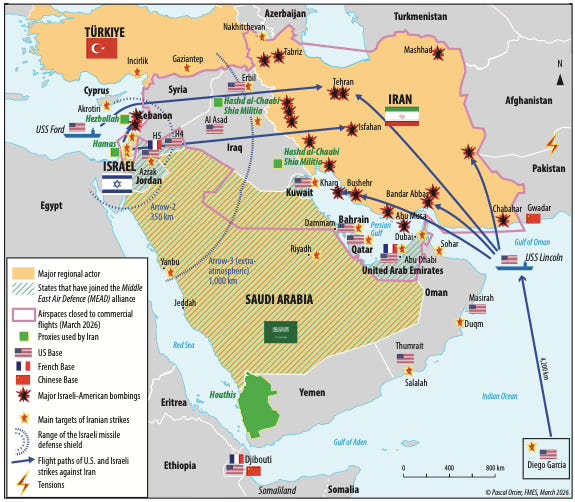
by Terry Miller, Antrim County Resident, and ChatGPT Plus
Sunday August 9, 2026
The Iran War: Staying informed.
Here is a concise breakdown of key milestones in the conflict, now in its sixth month:
Core Summary
February 28: War begins with massive joint US-Israeli strikes targeting Iranian nuclear and military infrastructure. Supreme Leader Ali Khamenei is killed in the initial barrage.
March-April: The conflict expands regionally as Hezbollah opens a northern front in Israel, prompting Israeli ground operations in Lebanon. Mojtaba Khamenei is named Iran’s new Supreme Leader. Iran effectively closes the Strait of Hormuz, driving up global energy prices.
May-June: Repeated clashes disrupt maritime trade routes as Washington enforces a naval blockade on Iranian ports. A Pakistan-mediated ceasefire and June memorandum briefly reduce large-scale fighting, but disputes over Hormuz, sanctions and renewed strikes prevent a durable settlement.
Late July-early August: Multi-front escalation resumes after Iran targets U.S. bases in Jordan. U.S. and Saudi forces strike IRGC positions in Iran and proxy targets in Iraq. Houthi attacks also threaten Saudi and Red Sea energy and shipping infrastructure.
Current Status
Status: Active combat. The war has entered its sixth month and has become a prolonged regional standoff rather than the quick resolution initially envisioned.
Key Flashpoints: The effective blockade of the Strait of Hormuz, attacks on Gulf and Red Sea shipping, cross-border missile exchanges, and proxy clashes across Iraq, Lebanon and Yemen.
Diplomacy: Oman is mediating indirect U.S.-Iran discussions over a shipping arrangement and a possible reopening of Hormuz. Iran says an agreement is nearing completion but continues to demand sanctions relief, compensation and an end to U.S. military pressure.
Economic Consequences
The war’s largest economic consequence is not the direct military bill. It is the energy shock created by the effective closure of the Strait of Hormuz. That cost travels everywhere—in gasoline, airfare, food, manufacturing, interest rates, and slower economic growth.
At home: the United States
1. Gasoline is the most visible cost
U.S. gasoline averaged more than $4.20 per gallon during the second quarter, compared with roughly $2.80–$3.00 before the war. Prices have since retreated; the EIA expects about $3.80 during the third quarter. U.S. Energy Information Administration
For Michigan, an analysis by the minority staff of Congress’s Joint Economic Committee estimated that the average household had spent an additional $502 on gasoline by mid-July. That estimate depends on assumed fuel consumption, but it captures the scale correctly: several hundred dollars per driving household, not merely a few dollars at the pump. Michigan Independent
A household with two vehicles, especially SUVs or pickups, has probably felt considerably more.
2. Air travel has become substantially more expensive
Jet fuel has risen about 65% since the beginning of 2026, while domestic airfares are reportedly 26.5% above last year. Not all of that increase is attributable to Iran—aircraft shortages, reduced competition and FAA staffing also matter—but the fuel shock is an important component. The Guardian
3. Food and ordinary merchandise are being affected indirectly
Higher diesel and gasoline costs raise the price of:
Farm operations and fertilizer
Trucking and refrigeration
Plastics and packaging
Restaurant ingredients and deliveries
Almost every product transported over a long distance
The March shock was especially pronounced: world crude prices rose nearly 40%, Asian LNG prices nearly two-thirds, and nitrogen-fertilizer prices nearly 50%. World Bank
For Masala Magic, the effects would appear less as one spectacular surcharge and more as accumulating pressure: food deliveries, cooking oil, packaging, employee commuting and customer reluctance to make discretionary trips.
4. Inflation is staying higher—and borrowing costs higher for longer
The Federal Reserve and other central banks face an unpleasant choice:
Cut interest rates to protect growth, risking renewed inflation.
Keep rates high to suppress inflation, weakening housing, investment and consumer spending.
The IMF says anticipated interest-rate paths have already moved upward because policymakers fear energy prices will spread into wages and other prices. Longer-term bond yields have risen as well. IMF July 2026 outlook
Thus the war can affect someone who buys no gasoline at all — through mortgage rates, auto loans, credit cards and business financing.
5. Taxpayers are acquiring a large future bill
The Pentagon placed direct war expenditure at $37.5 billion through late July, including projected costs through September 30. The administration has requested almost $90 billion in additional Iran-related funding. Reuters
That has not yet appeared as a special tax. It will instead become some combination of:
Larger federal deficits
Higher interest expense
Reduced spending elsewhere
Future taxes
Weapons inventories are also being depleted. Replacing costly interceptors and missiles will continue well after combat ends.
Abroad
Iran: economic devastation
Iran is experiencing the most severe direct damage:
Oil-export revenue has been curtailed.
Ports, power systems and industrial facilities have been damaged.
Sanctions and the U.S. blockade impede imports as well as exports.
Currency depreciation magnifies the price of imported food and medicine.
Businesses face shortages, closures and layoffs.
Exact Iranian statistics are difficult to trust during wartime, but reports indicate extraordinarily high food inflation and severe foreign-exchange stress. The economic pressure is real; whether it forces political capitulation is much less certain. Governments can survive economic misery considerably longer than their populations can comfortably endure it.
Gulf states and Iraq: enormous lost output
The World Bank has cut expected 2026 growth for Gulf Cooperation Council countries from 4.4% in 2025 to 1.3% in 2026. For the broader Middle East region excluding Iran, expected growth has fallen from 4.0% to 1.8%—a 2.4-point downgrade from the January forecast. World Bank regional update
Even oil-rich countries cannot profit fully from high prices when they cannot reliably ship the oil. Saudi Arabia and the UAE possess alternate pipelines, but those routes cannot replace normal Hormuz capacity.
Europe: particularly vulnerable
Europe imports energy and has less domestic cushioning than the United States. The consequences include:
Higher household utility bills
Higher industrial costs
Weaker consumer spending
Delayed interest-rate reductions
Greater recession risk in energy-intensive economies
Eurozone consumption growth fell to about 2.5% year-over-year in April, down from the previous 3–4% range. The ECB attributes much of that pullback to uncertainty and fear of lost purchasing power. Reuters
Asia: most exposed to physical Gulf supplies
China, India, Japan and South Korea normally receive most of the oil and LNG leaving the Gulf. Wealthier importers can pay more and reroute supplies; poorer countries such as Pakistan and Bangladesh have much less room.
China’s inflationary pressure has recently eased as Brent fell from above $110 to roughly $84, but its second-quarter growth slowed to 4.3%. The war is not the sole cause—China’s property and demand problems remain important—but expensive imported energy added to the drag. Reuters
Global shipping and inventories
Traffic through Hormuz is reportedly around 10% of its prewar level, with hundreds of vessels and thousands of crew members stranded. Aramco estimates that the disruption has removed 2.6 billion barrels from normal global supply flows and inventories—nearly a month of world consumption. Even reopening the strait would not instantly restore inventories, refinery operations or insurance availability. Reuters
Bottom line
The United States is inconvenienced and made poorer; Iran and parts of the Gulf are being economically battered; Europe and energy-dependent Asian economies face the greatest external danger.
For an average American household, the most defensible present conclusion is:
Several hundred dollars already lost through fuel and related prices
Potentially around $1,000 over the year when indirect costs are included
More expensive travel and goods
Interest rates remaining higher longer
A substantial federal war bill deferred to taxpayers
The hopeful fact is that oil markets have adapted better than feared: Brent has fallen from above $110 to the low-to-mid $80s. The dangerous fact is that this adaptation has consumed much of the world’s remaining cushion. A sustained Hormuz reopening would produce meaningful relief. Another major attack on Gulf oil infrastructure could reverse it very quickly.

“Never forget this: The forces undermining our democracy, rigging our economy, polluting our planet, and stoking hatred are counting on you to give up. Cynicism is how they win.”

Antrim County Democratic Party/Michigan
Chairperson: Veronica Welter, Chair@antrimdems.com
Website: antrimdems.com
Facebook: https://www.facebook.com/AntrimCountyDemocraticParty/
Volume #12. ANTRIM DEMS NEWSLETTER, WRITTEN AND ASSEMBLED BY SALLIE FOLEY, ALLEN WOLF, and JIM BLACK.
QUESTIONS/COMMENTS CAN BE DIRECTED TO SFOLEY@ANTRIMDEMS.COM
For more contact information, including Michigan senators and house representatives, visit our full contact information page by clicking HERE